James Allan
Isabel Arvers
Chris Byrne
Blackhawk
Brian Caiazza
Renaud Courvoisier
Ricardo Domiguez
EDITOR
Ian Epps
Marc Garrett
Jan Gerber
GH Hovagimyan
Jerome Joy
Steven Kaplan
Kasbah
Patrick Lichty
Joerg Lohse
Frederic Madre
Christina McPhee
Alan W. Moore
Robbin Murphy
Joseph Nechvatal
netwurker
nothing official
Darrel O'Pry
R.E. Poster
Keith Sanborn
Wolfgang Staehle
ART STOMP
Lydwine Van Der Hulst
Lee Wells
Philip von Zweck
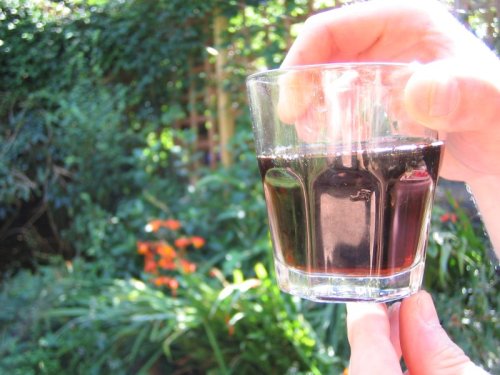
Many are aware that the creative activities and conceptual shifts of todays contemporary artists, are not easy to define as art in the traditional sense. Especially when much of the cross-cultural, relational contexts, canons and definitions of art are re-shaped by these two individuals, Kate Rich & Kayle Brandon. Who seem to effortlessly break through paradigms like there is no tomorrow.
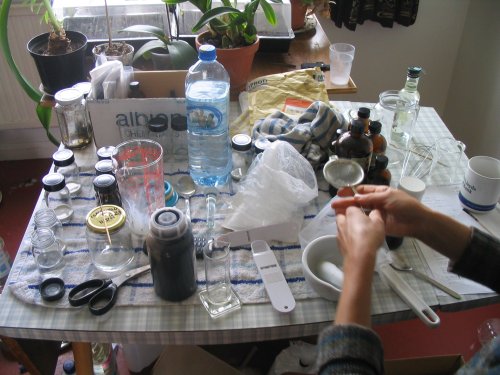
"We are wildcrafting our own cola from an online, open source recipe. A process developed through home-lab experimentation, merging domestic and scientific methadology." It says on the CubeCinema web site, which is also the venue in Bristol UK where they are selling the DIY drink.
With a hackivist consciousness or attitude, they are exploring the creation of their own version(s) of Coca-Cola. Both bar managers at the CubeCinema, have actively steered away from selling the 'real -thing', due to their feelings about the environmental practises of the multi-national company Coca-Cola. "We'd tried Pepsi and Virgin Cola and various others too," says Brandon, "but they weren't really a positive alternative. They were acceptable, but they weren't Coke. And people really want Coke."
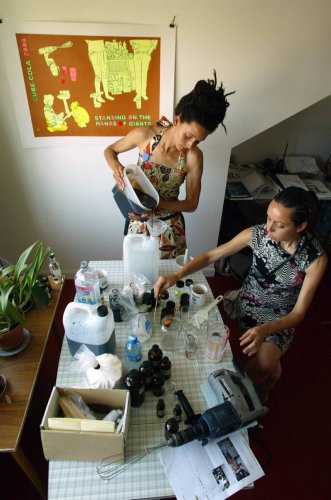
Cola is basically a mix of caramel, caffeine, sugar, fizzy water, citric or phosphoric acid, and eight essential oils. It's the precise blend of these oils that lies at the heart of the 7X secret formula. A trawl of the web soon uncovered several 7X-type recipes, the most promising of which was adapted from the one in Pendergrast's book. Guardian Interview/article.
Always interested in expanding beyond the limitations of mono-cultural practise, Kate & Kayle have also extended their current activities into a networked project that uses the Internet as a platform and distribution platform, offering their time for workshops to different venues and groups around the world."
They have even set up a database to supply growing demand of Cube-Cola at their distribution site called Feraltrade Courier.
I certainly intend to make an order myself:-)
| Attachment | Size |
|---|---|
| 1034.jpg | 51.04 KB |
| comp_02.jpg | 54.73 KB |
| guardian_pic_anna_barclay.jpg | 39.1 KB |
Hi G.H & Patrick,
Well yes, and I also feel that there is shift regarding creative expansion, offering a nod towards an imaginative, 'relational' behaviour (not in the canon orientated french meaning of the word), from a place of knowing about networks and their potential, as metaphor or templates, informed via the function and experience of knowledge sharing and distribution - along with that, introducing an element of craft or or ast least a sensibility towards it.
Putting forward a notion of 'value' that openly and actively reflects a tactile reasoning, which could be just as important, as the art itself. And not necessarily from didactic means alone but also from a place of acknowledgement, of an artistic and cultural need to (really) connect with contemporary issues and happenings, moving beyond the trap of technological determinism, or institutionally accepted protocols - thus intuitive exploration with skills on how to use technology but with a consciousness that is relating to real essences and situations that declaring alternative territories that are real yet, a sideways shift from traditional hacktivism or networked art.
I also see that the move to creatively challenge corporate agendas that many of our governments slackly impose on our lives, is not even a political action - it's an emotional stance that realises that we really are in a dystopian age, and religion and governments do not value humanity, only as currency and cultural weight for power and control. So, such practices reflect an intelligence of knowing what the real deal is now about putting it into a more socially engaged form of connectivity, less reliant on a need for mainstream acknowledgement or acceptance, but earthing one's self to the mesh of human relations, and the multi-expansion around such behaviours that incorporate such forms of visceral and feral agencies...
There's a kernal of a discussion on value that is really interesting. Do governments, religion, corporations bestow value? Is there such a thing as use value?
Right now I'm talking with my gallerists about the value of my videos. I can't put a price tag on them. There's no model for what I'm doing. I'm heavily represented at Art Basel Miami in 3 of [PAM]'s expo's. I'm so anti-market I can't conceive of ever selling anything. It's very odd.
ok, GH, then how do you make a living ?
if you have (like me) other resources than your art work to earn money and live then you are somewhat more free to do the art that you wish to do. on the other hand you have less time, which in itself is valuable: time
there is something I do not understand about what you state here:
if you don't need money from your art work, why sell it and be in an art show at all ?
if you do need the money then to me the computation of how much to sell it for I would find trivial. You know how much money you need to live by whatever standards you have now, then you can divide that to get an hourly "rate" of your standard of living then simply use this formula: add cost of materials to the time spent doing the work multiplied by that ratio
I would take into the "time spent" also the time you spend talking the dealer into actually paying this to you
the more the dealer wants to talk you into it the more expensive the piece you are selling becomes !
"ok, GH, then how do you make a living ?"
Making art has nothing to do with the market and/or if one chooses to use the market as an aesthetic position to work out of than it is a part of the work. The problem with current system is that artists believe their value and self worth are tied to the sale of their work. For instance the cube cola people are using a marketing structure to make art. That's very liberating.
"if you don't need money from your art work, why sell it and be in an art show at all ?"
That's my quandry and it has to do with digital video. I don't care whether I sell the work or not. The people presenting it want to try and sell it. I can't imagine that anyone would buy the work. I don't make art to sell in an art show. I don't make art to fit in a market.
I have to point back to Duchamp. Most of his work resides at the Philadelphia Museum of Art. It is an archive of sorts. Most of Duchamps work was ephemeral in nature. For example the famous R.Mutt Urinal was shown in Alfred Steiglitz gallery. It was then lost. Can you imagine an art dealer losing a valuble piece of art? Indeed, the urinal was a challenge to the market and the aura of the art object.
Duchamp didn't tell Steiglitz he wasn't interested in putting the urinal in a gallery. I suppose if someone was astute enough they would have purchased it. This is propbably the same thing with my videos. I don't make things to sell in the market.
ArtCal
dks.thing.net
Art Dirt Redux
V2V
Newsgrist
ambienttv.net
Artforum Artguide
Art Research Communication
Artists Meeting
MTAA
Rhizome.org
Brian Boucher
John Haber
Brian Sholis
Locus Sonus
ubuweb
studiolo54
DVBlog
location 1
furtherfield.org
squaringoff
Scratch Video
eyebeam reblog
eyebeam
[PAM]
Vernissage TV
as it relates to craft
This is a really interesting work that opens up a different position vis-a-vis the craft discussion put forth by Patrick Lichty. http://post.thing.net/node/1139
In this case it's a homespun or rather homebrewed stance against corporate hegemony. Check out their Feraltrade courier