
Families standing in the flooded Plaza de Mayo in Buenos Aires, holding photos of their disappeared, 1983. Photo by Daniel García.
Conceptual Art
Losing My Human Form...
Review of Art rétinal revisité: histoire de l’oeil
 Digitalarti Mag #4
Noisy Viral Threat : Joseph Nechvatal
Review of Art rétinal revisité: histoire de l’oeil
by
Manuela de Barros
Published in Digitalarti Mag #4
October 2010
The Back of the September 2010 Artforum
categories: artforum | bruno bischofberger | Conceptual Art | greg.org | magazine covers | prank | rob pruitt | september 2010
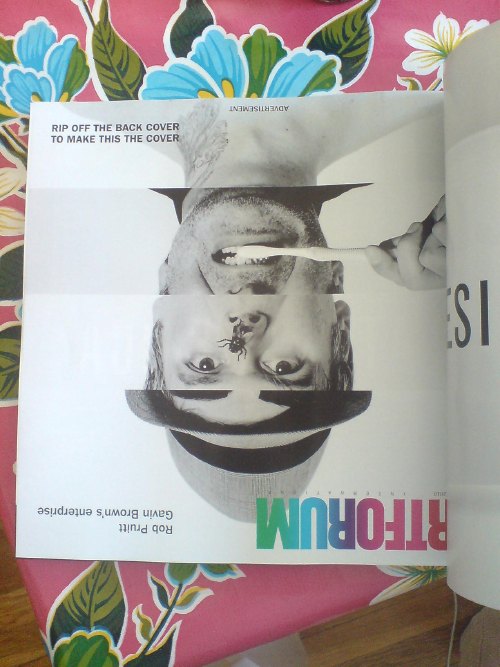
August 30, 2010. I've had the new issue of Artforum for a couple of days, but haven't thumbed through it yet. So thanks to greg.org for noticing this first.
The back cover of the magazine, since time immemorial, has been devoted to an advertisement for Bruno Bischofberger Gallery from Zurich, generally depicting a folky or bucolic scene from Switzerland in full four color bleed - and the current issue is no exception. Picking up on this art world axiom, conceptual prankster Rob Pruitt presents this as September 2010's penultimate page.
It seems Greg Allen "art directed" his presentation of RIP OFF THE BACK COVER TO MAKE THIS THE COVER by photographing it against a tabletop with a blue, green and lavender floral pattern that complements the colors of the ARTFORUM logo.
» Steven Kaplan's blog | login to post comments
Charlotte Posenenske Reconfigured by Rirkrit Tiravanija at Artists Space
categories: art | Artists Space | Charlotte Posenenske | Conceptual Art | gallery | James Kalm | opening | relational aesthetics | Rirkrit Tiravanija | sculpture | Soho
Rirkrit Tiravanija has established "Relational Aesthetics" as one the art world's current new movements. However, for this "intervention" he was invited to reconfigure "Square Tubes Series D", 1967, by Charlotte Posenenske with some personal alteration of the piece. Tiravanija decided to place all the Square Tubes on rolling dollies and invite attendees to simply roll them into whatever configuration they wish.
Damien Hirst: End of an Era at GAGOSIAN GALLERY
categories: Conceptual Art | Damien Hirst | diamonds | drawing | Gagosian | gallery | James Kalm | opening | Painting | Post-Modernism | sculpture
James Kalm joins throngs of fans, admirers and groupies to elbow his way through “The End of an Era” the latest offering from Damien Hirst. With his worldwide fame peaking from the recent auction of his work, which coincided with the global economic crisis, in “End of an Era" Hirst plays out his opulent critique of materialism. Featuring a pickled bull’s head, a gold plated case with nearly 30,000 manufactured diamonds and photorealistic paintings of renowned gems, this show displays a wide variety of medium and approaches used by the artist.
» James Kalm's blog | login to post comments
John Zinsser: Art Dealer Archipelagoes @ James Graham
categories: reviews | art history | art politics | Conceptual Art | drawings | james graham | john zinsser | maps | ny art galleries | pedagogy
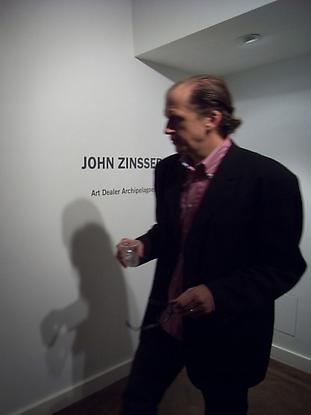
John Zinsser
Art Dealer Archipelagoes
Nov 20, 2009 - Jan 5, 2010
James Graham & Sons
32 East 67th Street
New York, NY 10065
http://www.jamesgrahamandsons.com/
(212) 535-5767

Holly Solomon Gallery
We can all readily cite John Donne on no man being an island, but somehow this inclusive, democratic sentiment never really applied to art galleries. Galleries seem rather to mirror the structure of small duchies in their aloof, quasi-diplomatic hauteur, their protective claims to territory and privilege, and their innate hierarchies: the semi-divine owner/dealer installed in the autocratic center, closely surrounded by a jealous court of advisers and directors, who assiduously attend to the "state visits" of wealthy collectors and influential curators in the snug recess of well appointed private rooms. In this extended metaphor, the icy gallerinas barricaded at the front desks serve as the gatekeepers, the scarecrows or the customs police.
On its own level, the gallery world can be viewed as a miniature recapitulation of the structures and protocols that attend to larger national or corporate regimes. This aping of status and importance is captured with dry, acerbic humor and meticulous historicist rigor by artist John Zinsser in this show of "archipelago" pieces, up at James Graham through January.
Urs Fischer: Marguerite de Ponty at the NEW MUSEUM
categories: video | Bowery | Conceptual Art | installation | James Kalm | Massimiliano Gioni | New Museum | New York | Paddy Johnson | Painting | photography | sculpture | Urs Fischer
James Kalm braves fall showers and trains his way to the Bowery’s New Museum for the first major museum exhibition by Urs Fischer. Lionized as one of contemporary art’s most distinctive talents, Fischer earned the New York spotlight in 2007 by cutting a hole in the floor of Gavin Brown’s Enterprise and digging out tons of dirt leaving a gaping crater for visitors to climb into and explore. As an astute observer of spatial perception, and a master of digital technology with a mischievous sense of humor, the artist uses the most advanced commercial printing techniques to tweak space and challenge “reality”.
Allan Kaprow's "Yard" Reinvented by William Pope.L at Hauser & Wirth
categories: Allan Kaprow | Conceptual Art | Happening | Hauser | installation | James Kalm | Painting | sculpture | William Pope.L | Wirth
James Kalm climbs to the top of the pile of tires in this “reinvention” of Allan Kaprow’s Yard at the debut exhibition of Hauser & Wirth New York. William Pope.L adds his own narrative text using a Barack Obama imitator, and flashing lights in this restaging. Upstairs we tour an in depth collection of posters, prints and documentation tracing the historic arc of this “Happening” which was originally created in this very location in 1961.
Ward Shelley Who Invented the Avant-Garde and other half truths at PIEROGI
categories: video | Conceptual Art | drawing | history | installation | James Kalm | Painting | Pierogi Gallery | Post-Modernism | sculpture | timeline | Ward Shelley
Is there such a thing as "Meta-Art"? Ward Shelley delves into the aestheticization of art history, mapping movements and individuals from art and pop cultural history. Despite his neutral approach, these works tend to show how the narrative is shaped, bent and fitted.
James Kalm catches up with conceptual artist Ward Shelley on the closing day of his exhibition “Who Invented the Avant-Garde and other half truths”.
Publication of Immersive Ideals / Critical Distances (Paperback)
categories: architecture | book | Conceptual Art | consciousness | information-technology | myth | sex | space | virtual reality | announcements
 Publication of Immersive Ideals / Critical Distances
