Works first time, every time.
http://www.mit.edu/~ruchill/lazycurator.html
It's been around for years, but I just saw it recently.

Works first time, every time.
http://www.mit.edu/~ruchill/lazycurator.html
It's been around for years, but I just saw it recently.

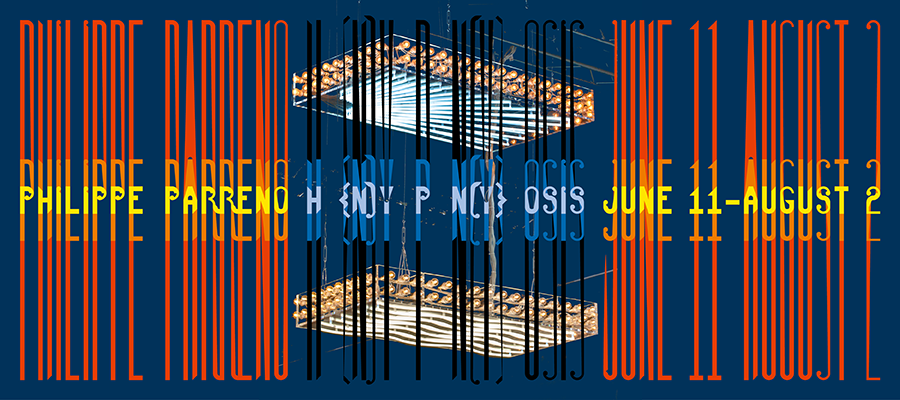
I've been advised that Parreno's marquee pieces deserve further discussion. They are, certainly, the dominant visual element of the H{N)Y P N(Y}OSIS installation at the Park Avenue Armory, marking the outline of Danny the Street and providing much of the illumination in the Drill Hall. The films and musical interludes might alternate, turning on and off in random sequence, but the marquees abide like sentinels or referees, providing strict framing of the playing field, defining the rules of the game.
When the circus comes to town, we are accustomed to a certain hierarchy of presentation. First there is the sideshow, often an allee lined with various attractions that are transitory and ephemeral: small, spicy, tender morsels that serve to whet our appetite for the main course, where the real business of the circus -- marching elephants, dancing bears, lion tamers, jugglers, tightrope walkers, aerial acts, the flying trapeze and such -- gets done under the Big Top.

GIF by: Anthony Antonellis
Art F City’s 10th Anniversary Benefit Auction
Bid Online Now on Paddle8
http://paddle8.com/auctions/artfcity
Live Auction and Benefit Party honoring Laurie Anderson
Monday, April 13, 2015
Lightbox
339 W 38th St
6:30 - 10 PM
Tickets on sale HERE.
The Artist as Debtor: A Conference about the Work of Artists in the Age of Speculative Capitalism
Friday, January 23, 2015
1-9pm
The Great Hall, Cooper Union
7 East 7th Street
New York NY 10003
LIVESTREAM: www.stopmotionsolo.tv

THE REAL ESTATE SHOW WAS THEN: 1980
APRIL 4-27, 2014
OPENING RECEPTION:
FRIDAY APRIL 4, 6-8PM
James Fuentes Gallery
55 DELANCEY STREET
NEW YORK, NY 10002
212-577-1201
info@jamesfuentes.com

http://hyperallergic.com/117512/protesters-rain-down-thousands-of-bills-...
"At 6:45 pm ET yesterday evening, a handheld bell sounded in the rotunda of the Guggenheim Museum in New York, signaling the second protest action in as many months from the Global Ultra Luxury Faction, or G.U.L.F. The ringing was followed by the release of 9,000 “1%” bills of parodic currency which fluttered downward as patrons rushed to the inner edge of Frank Lloyd Wright’s spiral ramp.
http://www.globalguggenheim.org/
Activists launch faux Guggenheim site with press release on Abu Dhabi:
Guggenheim Museum Announces Sustainable Design Competition for Abu Dhabi Branch

"In response to overwhelming international concern about human and labor rights violations in the construction of the new cultural district of Saadiyat Island, the Guggenheim Museum has decided to rethink the design for its new branch in Abu Dhabi. While the original design proposed by Frank Gehry is remarkable in conceptual and technical terms, the Guggenheim has recognized that the Abu Dhabi site affords a unique opportunity to fundamentally re-imagine the future of the twenty-first century global museum.
Art F City Roast
Monday, February 17, 2014
Postmasters Gallery
54 Franklin Street, ground floor
NY NY 10013
6:30 pm Cocktails & light fare
7:45 pm Live Auction
8:30 pm Award ceremony and Roast
Silent bidding runs through 10 pm.
BUY TICKETS HERE.
Early Bird Specials available through February 1.

Ido Michaeli, still from the Ethiopian Curtain of the Ark, 2013
Catalyzing Change: Contemporary Art & Social Justice
Presented by Artis & the New Israel Fund
Thursday, January 23, 2014, 6-8 pm
The Nathan Cummings Foundation
475 Tenth Avenue at 36th Street, 14th floor, NYC
$10 - advance registration only - includes wine and catered refreshments
Artis and NIF present an evening of art and conversation about social justice in Israel. Join them as they explore the intersection of contemporary art and social change, with a focus on the marginalized communities represented in the exhibition Centrifuge, presented by Artis and curated by Chen Tamir, on view at the Nathan Cummings Foundation through February 28, 2014.
