post.thing.net

headlines | about |

Gordon Matta-Clark, Doug Aitken and MoMA

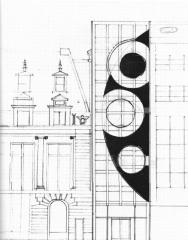
Proposal for MoMAProposal for MoMA
Just before Gordon Matta-Clark died in 1978 the Museum of Modern Art approved a proposal by him to cut into the façade of the original MoMA building before the first renovation and expansion of the building.
The piece was never executed. Gordon’s proposal was a bit of one-upsmanship on a certain level. Christo had proposed in the 1960’s to wrap the façade of MoMA but it remained a proposal. Cutting into the façade of MoMA was a lot more destructive than a gentle wrapping in canvas tarps.

The latest work to assault the edifice is the Doug Aitken projection work. Although I don’t know Aitken personally I was a friend of Matta-Clark’s. I find some very interesting parallel’s in their working methods and concerns. There are also quite a lot of differences. Matta-Clark’s work engages in a discourse with architecture. His work is also informed to a degree by the Situationistes notion of “détournement.” To cut into the MoMA façade is to critique the whole project of Le Corbusier’s “International Style” of architecture. Aitken on the other hand is dealing with a post-media environment where the architectural façade is a skin on which to project images. The dissolution of the minimalist architecture is accomplished by turning it into a screen. The images are part of a semiotic structure that is our 21st century world.

The issues of film and architecture were approached by Matta-Clark in many different ways. One such way was his “Underground Dailies,” piece. In this series Matta-Clark found ways to access spaces in New York that were not public with the purpose of shooting film such as the catwalks and utility tunnels behind/ in between the walls of Grand Central station or an abandoned subway tunnel, or the abandoned water supply tunnel by Grants’ Tomb or the new water supply tunnel that is 600 feet below ground.

I find a striking parallel in the way in which Aitken’s created his Sleepwalkers piece. Aitken’s shot film in areas with similar meaning in relation to the whole urban fabric of New York City. He shot in an abandoned subway tunnel, the unused helicopter pad of the Met Life building and behind the newsreader in Times Square. What I like about Aitken’s work is his sense of the city as a whole having a body and acting somewhat like an entity with a skin and a nervous system. Matta-Clark had a similar take on the city. In an early film montage work Matta-Clark spliced four films together vertically. He then projected them onto a wall constructed like a vertical ziggurat for an exhibition at the Holly Solomon Gallery. Technically the piece resembled earlier films done by the Dadaists but the addition of the architectural element put the work into the realm of sculpture installation art. In any case the multiple screens and disjunction caused by projecting Aitken’s work on various MoMA surfaces can be read as part of the same discourse on film and architecture.


Wolfgang Staehle and Gordon Matta-Clark

The dialog with architecture and projections was also approached by Wolgang Staehle in his projection piece done for the Spring (2006) Art Fairs on the Pier in New York city. In this case Staehle brought the outside in by setting a webcam view of the New Jersey shoreline across the Hudson River from the piers. This reminded me of the intervention on an abandoned pier in 1975 by Gordon Matta-Clark called Day's End in which Matta-Clark cut a giant hole in the front corrugated facade of Gansvoort pier, essentially bringing the outside in.


more matta-claitken

Quiet an interesting comparison, gh.
I think it opens up a can of worms!
Especially when -once again- the infectious spirit of your old buddy Gordon Matta-Clark is resurrected.
Aitken always impresses in his deep, multi-layered and unpredictable style of juxtaposing imagery, and I imagine it must look fantastic on the MoMa walls. But after all there is nothing really innovative by the fact that he does an outdoor video projection on a building. It looks to me that there is no clear site-specific context. Or is there? Also, it is not even done in a public space (neither was this Aitken's intention of course) But we have to recognize the motivation here: It's rather like MoMa allows one of his boys to play in the well-protected back yard (Noticed? Taniguchi raised the concrete walls)
Not to diminish Aitken but you brought Matta- Clark into this discussion. So, let's face it: How insignificant and boring looks media art today against these courageous, most radical works by Matta- Clark, driven by so much passion and obsession. His "Anarchitecture" in opposition to AItkens projection? The opposition might be "comforting" architecture with nice images. With or without a significant contextualization.
What Matta-Clark's and Aitken's inevitably have in common is the fact that their work is ephemeral - for different reasons.
It would be worth to look a bit closer on the circumstances that made them ephemeral, as Matta-Clark's work could only exist in buildings ready for demolition*.
Apart from video's time-based nature, Aitken comes as close to eternalism for video art at Moma, although I suspect ConEdison is probably the ultimate reason to make this project temporal.

I recently came across a live projection work by Mexican video artist Fernando Llanos, who I believe captures much more of Matta-Clark's spirit - if we imagine how the latter might work today with video projections on buildings.
Llanos constructed a powerful moving projector unit that is battery powered and wearable (It looks like a giant steadycam) As being an participating artist of the 5th Mercosur Biennale in Porto Alegre, Brazil, he walked with his projector through the giant exhibition space projecting his art randomly on walls often even on top of other artists work. (video)
In a more recent "intervention" he projected airplane disaster footage at the walls at the entrance of the main terminal of Benito Juarez International Airport. (more video)

When speculating how Matta-Clark's work could have evolved over the last three decades it seems ridiculous to paint the image of Matta-Clark, as the eternal art anarchist. On the other hand he died young and therefore created undeniably an incredible myth. Call it Matta-Clark, the James Dean of Conceptual Art.
As everybody agrees, a rebel's life is mostly unrewarding. Doug Aitken sips champaign at his MoMa opening, Matta-Clark got an arrest warrant right before his "Day's End" opening and had to flee the country.

*I always wonder how Matta-Clark would be remembered if "Office Baroque" (1977) in Antwerp had survived
Recently I came across an article by Matta-Clark's widow, Jane Crawford, about the tragic struggling and ultimately unsuccessful efforts in preventing the demolition of this building.


the case against cleavage

"I would like to interrupt here to make a remark." *1

"Cutting into the façade of MoMA was a lot more destructive than a gentle wrapping in canvas tarps." Not really, especially if Mahatma-Clark was proposing a cut and paste before an even more destructive renovation and I wouldn't describe Aitken's projection as an assault any more that I would say a kid pissing on the bricks at 3 am was an act of vandalism.

Re: WS vs the other 3 mentioned earlier

These 3 work with plastic surface in space whereas WS deals with space as plastic surface (like MS in 'Wavelength'). Is it that he recognizes the curvelinear translation of 4D into 3D as a rendering of 2D + time so space/time gets all mixed up and bubbly like a metafizzical root beer float? As we know, at an atomic level the geography of the universe is easily traversed and those pesky electrons move faster than a curry fart through silk sheets at the Ritz so why are artist's still banging their heads against the wall of institutional inviolability and causal inevitability? Relax. Take a deep breath and fill your heart with joy. Stephen Hawking and Curtis Mayfield are holding hands, rolling down Route 66 into the sunset with Debussy's 'Clare de Lune' playing as the credits roll and fade softly into black. But I digress. The real question isn't that of subjecting surfaces to penetration with selfish intent but a different, more gentle, vital question which, at the moment, seems to have slipped my mind.

*1 Richard P. Feynman, The Development of the Space-Time View of Quantum Electrodynamics
http://nobelprize.org/nobel_prizes/physics/laureates/1965/feynman-lectur...

P.S. The phrase "middle-class invulnerability" didn't make it into the final draft but if it did, fyi, it's taken from an article on a UK tv show: Skins (http://www.guardian.co.uk/tv_and_radio/story/0,,1998933,00.html).


Nonument

Here's a terrific article on G M-C that Christina McPhee forwarded to me.

http://yoda.hnet.uci.edu/fvc/vsgsa/octopus/octo_archive/vol-01-f2005/zal...


NYTimes article on Matta-Clark

Here's the permalink to the Times piece on Matta-Clark.

http://www.nytimes.com/2007/02/23/arts/design/23matt.html?ex=1329886800&...


Thank you very much for this

Thank you very much for this useful article. I like it.

Regards
------------
Sohbet