summer exhibition at Brooke Alexander Gallery
http://www.baeditions.com/Installation%20Views/Colab%20Redux/Colab%20Red...
Colab (officially Collaborative Projects, Inc., founded 1977) was one in a string of New York City artists’ groups that started most strongly in the 1960s. Artists’ groups have had an escalating impact on the conventional art world. Today a number have roughly equal status with prominent individuals.
[Note of disclosure: I was a member of Colab, and have published on the group’s activities.]
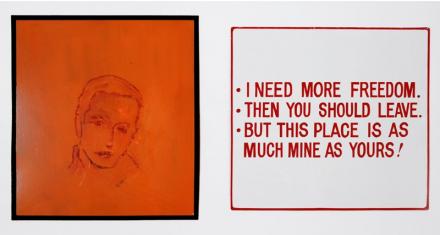 Jenny Holzer & Peter Nadin
"Colab Redux"
The group Colab experienced its moment of triumph in 1980, with the Times Square Show. Almost immediately, it was looted of several key members by the art dealer Brooke Alexander. Now his gallery mounts an exhibition entitled “Colab Redux.”
“Looted”? A strong word. Really, there’s no blame. Brooke Alexander simply seed his opportunity and he took it. At that moment there was no reason to think that Colab was anything more than a new sort of cooperative galley, like AIR or 55 Mercer. And wasn’t it, as Walter Robinson once described it, like a “farm team” for the big leagues of the artworld?
Like a record company A&R man, Brooke Alexander was simply there the fustest with the mostest (cash). In offering all those artists one person shows, diverting their energies to making a solo bang in his gallery space – he strip mined the collective. Money changes everything. So what?
Artists’ groups are inherently unstable, shortlived. You can give ‘em a push. And now we understand, as Margaret Thatcher explained after the Wall fell in ’89, that there is no alternative to hyper-capitalism. Our increasingly totalized global cultural experience is mediated only by the complete equivalence of cash. Now we are offered Brooke Alexander’s “Colab” as a chunk of unexplicated disconnected work done by people who knew each other at a moment in time. You know, a group. Like the Impressionist “group,” or something.
For years Colab made contest with the “bureaucrats” of New York’s non-profit, institutional alternative spaces. Then many members took up the offers and conditions of private capital. Key members of the group abdicated their emerging collective political and cultural position for their careers. Colab became Coliberal. Hey, no problem. It was the ‘80s. Reagan was gonna pull the alternative money plug anyhow. And after all, why are you in New York?
Those decisions led to a dramatic diminution of what we may call Colab’s social capital, its reputation. The historical trajectory of the most significant artists’ collectives is political and social. They play key roles in cultural and political movements. These are not primarily economic self-help groups. To draw them down and demean them is to damage their historical positionality in the grand tradition of which they are a part.
“Colab Redux” now reinscribes for a new century the moment when group two of Colab devolved. Now it’s Coneoliberal.
Yeah, yeah, whine, whine. But people gotta eat. And they gotta do bizness. This sarcastic critique is unfair to a striving dealer with a bunch of vintage stuff he’d like to roll out.
Unfortunately, the show is senseless. Sure, most of the people exhibited here were in, or had something to do with Colab, or worked with others who worked in the group – but why are these things on the wall with that name above them? No explanation is attempted. No essay. No catalogue.
The show speaks to the New York commercial artworld’s love of a lack of historical context. This is the favored operational mode of thieves, and a reflexive habit among most antique dealers. Everything is “merch.” (“It’s a nice piece.” – “Where’d it come from?” – “Do you really care?”)
Still, congratulations to Brooke Alexander, longtime publisher of innumerable lovely editions, for raising the question. Although he has no answer, and I cannot pass up this opportunity to give him a hard time, his problem is that there has been no context established for saying “Colab” in a contemporary exhibition. Why? New York City’s art institutions traditionally don’t give a shit about the cultural history that takes place in their city. They make little effort to explain it to the city’s public. There has never been a retrospective exhibition about Colab – or any of the other organizations, groups and scenes that fed into it.
The tiny exceptions comprise a pathetic list. “A Partial View of Fashion Moda: Photographs by Lisa Kahane,” Lehman College of Art in 1996; they cut out the graffiti (the soul of Fashion Moda) ‘cause it might offend the politicians. Julie Ault’s important “Cultural Economies: Histories from the Alternative Arts Movement, NYC,” at The Drawing Center in ’96, from which came a book to multiple printings. Matthew Yokobosky’s “No Wave Cinema, 1978-87” at the Whitney in ‘97 began to engage some of the media material of the era, most of which is not being preserved. (But really, who care about artists’ video?) Dan Cameron’s “East Village USA” at the temporary New Museum in ’04 was a good effort.
This institutional shortfall can’t be because audiences don’t like this kind of history show. The Tate Liverpool had to do NYC’s ‘60s in “Summer of Love,” and feed it back to us. Big success. When NYU’s Grey Art Gallery finally did “The Downtown Show: The New York Art Scene, 1974–1984” in which Colab figured, it traveled the country.
But still, NYC art institutions are allergic to dust. They got a lot of stuff, but they really don’t like the dull effort of thought required to make enough sense of it to show it. (It’s like negotiating with tenants – Boring! Rather be flipping.) In a real sense, Colab’s war with the institutions of art continues. This is a position they share with nearly every other artists’ group of the past 50 years, and all the now-vanished cultural districts of the city.
Like a starved and skinny beast, Colab and its confreres haunts the halls of New York museums, searching endlessly for a vitrine. Perhaps this is best… Let Colab remain among the legions of unquiet dead. Except for the parts of it that got sold, Colab is still part of the undercommons – “Legendary” – like the werewolf. Here’s to the moonrise.
 Jenny Holzer & Peter NadinJenny Holzer & Peter Nadin
Cranky Old Man with an Ax to Grind
Thanks, Robin, for your reflection on aging. I think of myself as an “old man,” but not as elderly. Maybe because that term always comes up in the sense of people who are getting into trouble because of physical incapacity, like can’t be evacuated from Katrina’s path, and so on. We’ll get there soon enough, but ain’t there yet. And all these memories… they are presently encased in brains made new over a few times, I guess.
Anyhow, I worry when I blast away at cultural actors. So, after posting this screed, I thought it over again, what is the basic disagreement here. I think it is a matter of projecting my definitions onto Brooke Alexander and his gallery enterprise. My anger comes from disappointed expectations. The notion, with which I was trained, was that there exists a creative community in which dealers support artists' initiatives as well as sell their products. It’s an old-fashioned idea, I guess, left over from the days of small magazines and poet-critics. Brooke Alexander was much more in tune with today’s art = capital reality. The initiatives that are supported today build capital, not community. Uh oh, I’m starting again...
What I meant to say is that I privilege a different model of collaboration than Brooke Alexander. And Colab was exactly this – Collaborative Projects, not collective projects. The difference – especially 30 years ago, when the Cold War was still full on – was in perceived political engagement. So it is only the “third hand” that’s on show here. That is, in terms of frames for artists working together, this is the Charles Green version of collectivity which is collaboration. It’s not the Blake Stimson & Greg Sholette version of collectivism after modernism, which ultimately about what Gerald Raunig called “instituent practice.”
If Colab was about artists collaborating to make gallery objects, then this show was mostly pretty on point. It spotlights the Nadin/Holzer colab, which hadn't anything really to do with Colab at all. (Although it did have to do with the short-lived Colab spin-off called Offices of Fend, Fitzgibbon, Holzer, Nadin, Prince and Winters.) So rather than “Colab Redux,” this show might better have been called “Collaborations of the '80s, with Some Artists Affiliated with Colab.” That’s precise.
-- Comwaag