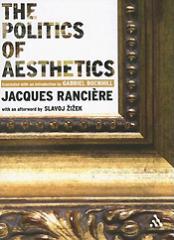
 The Politics of Aesthetics
Book Review of Jacques Rancière’s The Politics of Aesthetics : with reflections on Rancière’s art-politics in lieu of the Deleuzian/Guattarian perspective.
by Joseph Nechvatal
Jacques Rancière, The Politics of Aesthetics
With an afterward by Slavoj Zizek
Continuum Press, London and New York
Jacques Rancière is interesting to me in that he is a critic of defined disciplines/specializations in favor of a ground of aesthetic pleasure brought about through a non-identification with one’s identity (and/or condition) - even while he stresses a refusal of containment/confinement that is simultaneously escapist but possibly emancipatory in its transformational suggestivity. In other words, he believes in the powers of the imagination.
In his book The Politics of Aesthetics Rancière comes right out and declares as much already in the forward when he states that he is concerned here with “aesthetic acts as configurations of experience that create new modes of sense perception and induce novel forms of subjectivity”. (p. 9) So, first off, how can “new modes of sense perception” be created which can potentially help remove the subject out of his/her glib indolence? We will here examine that. Then I will compare and contrast some of Rancière’s approach to art and politics with that of the philosophic rhizomatic theory (1) of Gilles Deleuze (and Félix Guattari), which, at a general level, supports such an interdisciplinarian connectivist approach – as their rhizomatic theory encouraged non-linear and non-restrictive interdisciplinary thinking-doing.
I: new modes of sense perception
“What is real is the becoming itself, the block of becoming, not supposedly fixed terms through which that which becomes passes.”
-Gilles Deleuze and Félix Guattari, A Thousand Plateaus
The context here for new modes of sense perception is established precisely by touching on some recent realizations about the current international art scene that I have been experiencing and reading about, most devastatingly in Julian Stallabrass’s small book Contemporary Art: A Very Short Introduction. In it Stallabrass describes a theory of the art market which well explains the current art world’s situation, specifically arguing that behind contemporary art's multiplicity and apparent capriciousness lies a bleak uniformity and that this amounts to making culture uncurious, timid and stupid in the service of a big business ethos of unquestioning consumer conformity; a pop ethos apparently enforced by some dim-witted and unspoken social-climbing consensus. Rancière himself stresses that art in itself is not liberating and can be quite the opposite, depending on the “type of capacity it sets into motion”. (March 2007 Artforum, p. 258)
Stallabrass purports too that the unregulated insular contemporary art market seeks to dupe newbie art rubes into being enthusiastic participants in the dumbing-down values useful to big business; values which address all communications to the lowest common denominator of the mass. Yes, that sounds un-emancipatory to me – but also a true reflection of the deceptive and self-deceptive Cheney-Bush neo-con epoch that we are enduring. So, the obvious question is: what new modes of sense perception are possible according to Jacques Rancière if one takes seriously art’s responsibility of resistance?
It is disappointing to report that Rancière does not answer this central problem of art-politics in this book, nor does he address the central situation in which we find ourselves where all political gestures and critical images are potentially consumed and neutralized in the happy inferno of market commercialization (See the recent book Critical Mess: Art Critics On The State Of Their Practice edited by Raphael Rubinstein). Kristin Ross’s assertion, in her March 2007 Artforum essay “On Jacques Rancière”, that such market mental “shackles”, can somehow be, via Rancière, “set aside” and even “denounced” (p. 255) seems Pollyannaish in the extreme. In my view, one can only even attempt what Rancière calls an “opening in the consensus” from the formal point of view of art that is generally excluded through difficulty from the interest of the market. This signifies a self-understanding and self-construction beginning with what Deleuze and Guattari call "an intensive magnitude starting at zero". (Deleuze & Guattari, 1987, p. 153) This $0.00 worth of course means the vast majority of art created, but certain formal factors help assure this unmarketabilty ideal at present, factors such as: dark nihilistic over-complexity (the dreaded inaccessible factor), electronic impermanence, art which is overly ambiguous, punk noise, and so on.
So I was wondering while reading Rancière’s The Politics of Aesthetics last year what Rancière had to say about contemporary art’s lost commitment to the idea that the core of fine art is that which purports to transcend the banal economic world and portray a wider vision of political awareness inclusive of private spiritual, ecstatic or magical themes accessible through the subjective realm of each individual; a self-perceptional politics which reveals in minute particulars the wide-ranging spectrum of the social-political dimensions of the human mind. I’m sorry to say he says nothing specific, but does seem to favor such an approach in general. But the question of how artists and dealers and critics prevent the market from eliminating that quality from art – and in so making particularly the younger people, opportunely unintelligent – is not addressed in The Politics of Aesthetics. That is the pity, as he leaves us wretchedly alone to consider the difference between politically visionary art and market vision, with its mechanical functionalism. So one must grapple.
For me the formal difference is in looking into and projecting onto something - thereby discovering an emerging manifestation, as opposed to looking AT something. In that sense it requires an active but slow participation on the part of the viewer - and a politically visionary art style demands as much. This required user mental participation is essential in our climate of mass-media / mass-market / mass-think in that it plays against the grain of given objective consensus. In that sense politically visionary painting, for example, becomes more a service product than an investment object.
Moreover, my deep feeling, which Rancière also ignores, is that today art must indict - or at the very least play the role of the jester who unmasks the unspeakable lies of the powerful. It is now widely recognized that Americans (and the Western World for the most part) have been deceived and victimized by governmental propaganda and if art cannot rebuff and contest this grave situation by fueling the political will and imagination of resistance, I wonder why we need it at all - other than to make rich people richer. In the current political world it is painfully obvious that we need investigative strength of mind to heal our intelligence, and so an art that demands a mental mood of investigation would support such a need.
Fortunately Rancière does encourage a complex and ambiguous politically visionary art of resistance and investigation; one which would be increasingly valuable to an analytical social movement based on skepticism while undermining market predictabilities as it strengthens unique personal powers of imagination and critical thinking. This is so as Rancière urges us to counter the effects of our age of simplification - effects which have resulted from the glut of consumer oriented entertainment messages and political propaganda which the mass media feeds us daily in the interests of corporate profit and governmental psychological manipulations – what he calls the “representative regime”. (p. 22) This ambiguous politically visionary aspect of art is what he terms the “phantasmagorical dimension of the truth, which belongs to the aesthetic regime of the arts”. (p. 34)
Unreservedly Rancière addresses the existence of this inner phantasmagorical true world - the life of our imagination with its intense drives, suspicions, fears, and loves – which guides our intentions and actions in the artistic, political and economic worlds. Indeed Rancière makes clear that our inner world is the only true source of meaning and purpose we have and a participatory politically visionary art of investigation is the way to discover for ourselves this inner life. So we see now that in contrast to our market-frenzied materialist culture, which trains us to develop the eyes of outer perception, a politically visionary phantasmagorical style of art could encourage the development of inner sight based on the individual intuitive eye. Of course Rancière acknowledges that this politically visionary realm embraces the entire spectrum of imaginary spaces; from the infinitude of actual forms to formless voids of virtuality.
In this light, Rancière might even say that hot market artworks have lost their artistic worth by being reduced to poker chips. Not that that is the artist’s fault. But what does he say about artists that utilize his critical phantasmagorical formal via optical strategies to thwart such abuse? I have yet to discover a reference to them in any of Rancière’s mediations on art and politics.
Thus for the practicing artist/theoretician it remains more relevant to consider the phantasmagorical true aspects (in this sense the thwarting aspects) which remain detectable in the Deleuzian/Guattarian fertile philosophical articulations concerning nomadic thinking-making (2), as they have taken into account the rich ensemble of art and political relations possible: the diversity, the unexpected links, the ruptures, the amalgamations, and the connected heterogeneity. In that sense, Rancière is only repeating in watered-down form what Gilles Deleuze and Félix Guattari showed us over twenty years ago. Even then their vision of nomadic life re-opened the way for the phantasmagorical production of subjectivity in art (in lieu of the objective market) by affirming the befittingness of difficulty, variety and the necessary right to dissension. Deleuze/Guattari already have outlined new modes of sense perception which help induce novel forms of subjectivity, forms that would be composed of variously formed segments, stratas, and lines of flight which involve territorializing as well as deterritorializing spacio/psychic activities. (Deleuze & Guattari, 1983, p. 2) Granted, Rancière’s ideas about the regime of the critical phantasmagoric relate here as well.
II: new modes of political perception
“Only a bad artist thinks he has a good idea.”
- Ad Reinhardt, from Art as Art, The selected writings of Ad Reinhardt
In The Politics of Aesthetics, Rancière stresses that both art and politics reconfigure what is possible to say at a given moment (pp. 63-66) - a reconfiguration made possible by, in his words, “undoing the formatting of reality produced by state-controlled media…” (p. 65) Let us test that thesis of reconfiguration in the actual art world. Shall we?
In the last year I have become intellectually interested in what is called in the United States the 9/11 truth movement. This is a consciousness movement made up of people, including many scholars, who desire to learn the truth about what really happened on 9/11/01 and who was behind the conspiracy that carried it off. Obviously, this social grass-roots movement is based on the presumption that the government’s story is not fully true, indeed parts of it are demonstrably false, and that we cannot take the current government’s statements and explanations on faith any longer. In that sense the movement is skeptical and so thereby motivated by the desire to pursue knowledge of the truth.
When I first became engaged in following these issues, the movement was quite marginal and rather demeaned as being made up of “conspiracy theorists”. This appealed to me however, I admit, not because I have any interest in conspiracy theories, but in that I was involving myself with Jacques Rancière’s ideas about the visible and the invisible, and the spoken and the unspeakable - as this investigation was - and is – issue packed with ideas of false flag (black) operations that should or could not be spoken of in public. Thus I sensed a bona fide taboo here at work, as enforced by the mainstream media and social norms, which I sought to contravene. Surely the art world was an open forum for any and all aesthetic investigation. But no. After I told an important Chelsea gallery that this critical subject of false flag operations was to be the main theme of an exhibition that they had proclaimed to be desirous of doing on my work, all contact with me was severed and the exhibition nixed. I assure you that this did not dismay me in the least. Soon I became increasingly fascinated with some speculative gray areas of this topic, but rapidly restricted myself to the empirical evidence that tends to disprove the official government narrative that was established immediately – and then verified in the 9/11 Commission Report; a report directed by a White House insider named Philip D. Zelikow. The research of Dr. David Ray Griffin is invaluable in that regard; research that has been generally ignored in the mainstream media.
But since then, fairly recent polls in the U.S. clearly show that the government's own unproven conspiracy theory is losing ground and more and more people are waking up to their pattern of lies and are asking questions of authority. Indeed, I asked myself just what is conspiratorial about demanding a thorough impartial examination of that horrendous event on 9/11 – an event that has been used to justify illegal invasions and have destroyed two countries and killed tens of thousands of people?
There is much we saw that day that is suspicious, perhaps most staggeringly that no air defense was effectively used for over an hour and a half time period. Then I learned there were secret multiple war-games taking place at exactly the same time that day, thereby making it impossible for air defense to distinguish the real from the simulation, and thus removing the first-rate air defense from New York and Washington skies. These war-games, which were under the direction of the Vice-President Dick Cheney, comprise the very heart of what many suspect is a black operation performed by a small neo-con faction of the Republican administration. Can it only be a coincidence that the morning of 9/11 both FAA and NORAD were occupied in air defense drills simulating multiple airline hijackings?
There is absolutely no excuse for anyone who supports art, peace and civil liberties to support governmental lies. We know now that the current U.S. government must now be assumed to be lying until proven otherwise. At the same time the Bush administration acknowledges that it has dramatically increased the number of documents classified "confidential," "secret" or "top secret." Between the time Bush took office in 2001 and 2004, the most recent year for which figures are available, that number has nearly doubled. In 2004 alone, 80 federal agencies deemed 15.6 million documents off-limits. And that figure doesn't include documents withheld by Vice-President Cheney, who refuses to report to the National Archives the number of documents his office classifies, even though Bush's executive order requires him to do so. Cheney claims his office is exempt. I, and others, desire to know just what are they hiding? If there’s nothing to hide, why is the U.S. government hiding everything? So where is Rancière’s critical phantasmagoric art that expresses the desire for an impartial investigation to ascertain the truth? Nowhere to be seen.
Following Rancière mandate, it is important to cut through the unseeing and unsaying here, as we must consider that the official account of the 9-11 attack on America is actually a phantasmagorical conspiracy theory, given that it lacks much credible proof. It is therefore subject to being judged on the same basis as any other phantasmagoric theory, that is, skeptically examined through logical inquiry. Therefore, unless the events of 9/11 are critically examined and discussed through art in the search for truth without apprehension, nothing Rancière says about art and politics are of meaning, just as nothing we are politically living is true.
III: new animal modes of political and artistic action
“Art perhaps begins with the animal, with the animal at least who carves a territory...”
-Gilles Deleuze from Gilles Deleuze and Félix Guattari, What is Philosophy?
Even so, or until then, Rancière acknowledges that all methods, explanations, and theories (including his reconfiguration of the sensible – which, btw, smacks of portions of Deleuze’s book Logic of Sense) inevitably distances consciousness from its first sense of full and total participation. For this full sense we need the body engaged and hence Deleuze/Guattari's emancipatory interest in "becoming-animal" is accommodating. For them, to "become animal is to participate in movement, to stake out the path of escape in all its positivity, to cross a threshold, to reach a continuum of intensities where all forms come undone, as do all the significations, signifiers, and signifieds, to the benefit of an unformed matter of deterritorialized flux, of nonsignifying signs". (Deleuze & Guattari, 1986, p. 13) Whether this discovery of animal honesty through Rancière’s desire for critical phantasmagoric truth is possible and thus is capable of delivering Rancière’s hoped for a change of sensibility (p. 10) remains an open and fascinating question. But what strikes me today is that even in the midst of our fervent political angst - based on our current conditions of great distrust and deception coupled with feelings of helplessness – current interest in Rancière’s critical phantasmagoric remains justified, if somewhat redundant given the gifts of consciousness we have already received from Deleuze and Guattari. Yet as Rancière urges, we may not restrict nor resign our consciousness to the unsayable and the undoable in art and politics, for according to Deleuze, consciousness itself is "the passage, or rather the awareness of the passage, from less potent totalities to more potent ones, and vise versa." (Deleuze, 1984, p. 21)
Notes:
This review/essay is informed by an email and snail mail letter I have written to Jerry Saltz in response to his Village Voice essay “Seeing Dollar Signs: Is the art market making us stupid? Or are we making it stupid?” (unanswered and unacknowledged) now posted on my blog at http://post.thing.net/blog/244 and to an email I sent Rosalind Krauss following her March 27th talk at La Maison Française at New York University (unanswered and unacknowledged). Also it benefited from a hypothetically ongoing, but currently stagnant, interview of myself by Catherine Perret (For the completed Part I see: http://www.eyewithwings.net/nechvatal/2new/Perret-Nechvatal%20talk.htm) I must also note that regardless of Rancière statement in his March 2007 Artforum interview with Fulvia Carnevale that “I write to shatter the boundaries that separate specialists…” (p. 257) I was unable to locate an email account for him using the standard google search engine to discuss these views directly with him.
(1) In the philosophical writings of Deleuze and Guattari the term is used as a metaphor for an epistemology (that in philosophy which is concerned with theories of knowledge) that spreads in all directions simultaneously. (Deleuze & Guattari, 1994, p. 7) More specifically, Deleuze and Guattari define the rhizome as that which is "reducible to neither the One or the multiple. (...) It has neither beginning nor end, but always a middle (milieu) from which it grows and which it overspills. It constitutes linear multiplicities with n dimensions having neither subject nor object... ." (Deleuze & Guattari, 1987, p. 21)
(2) It is pertinent that in A Thousand Plateaus Deleuze and Guattari describe this shift towards boundlessness as one's becoming a body without organs (BwO) in terms of our self-shifting representational planes emerging out of our field of compositional consistency, for the BwO (according to them) is an insubstantial state of connected being beyond representation which concerns pure becomings and nomadic essences. (Deleuze & Guattari, 1987, p. 510) Deleuze and Guattari go on to say that the BwO "causes intensities to pass; it produces and distributes them in a spatium that is itself intensive, lacking extension. It is not space nor is it in space; it is matter that occupies space to a given degree - to the degree corresponding to the intensities produced". (Deleuze & Guattari, 1987, p. 153) According to Brian Massumi, the translator of A Thousand Plateaus, the BwO is "an endless weaving together of singular states, each of which is an integration of one or more impulses". These impulses form the body's various "erogenous zone(s)" of condensed "vibratory regions"; zones of intensity in suspended animation. Hence the BwO is "the body outside any determinate state, poised for any action in its repertory; this is the body in terms of its potential, or virtuality". (Massumi, 1992, p. 70)
References:
Deleuze, G. 1984. Spinoza: Practical Philosophy. San Francisco: City Lights
Deleuze, G. 1990. Logic of Sense. New York: Columbia University Press
Deleuze, G. and Guattari, F. 1983. On The Line. New York: Semiotext(e)
Deleuze, G. and Guattari, F. 1984. Anti-Oedipus: Capitalism and Schizophrenia. London: Athlone Press
Deleuze, G. and Guattari, F. 1986. Nomadology: The War Machine. New York: Semiotext(e)
Deleuze, G. and Guattari, F. 1987. A Thousand Plateaus: Capitalism and Schizophrenia. Minneapolis: University of Minnesota Press
Deleuze, G. and Guattari, F. 1994. What is Philosophy?. London: Verso Books
Griffin, D. R. 2004. The New Pearl Harbor: Disturbing Questions About the Bush Administration and 9-11, Olive Branch Press
Griffin, D. R. 2004. The 9/11 Commission Report: Omissions and Distortions, Olive Branch Press
Griffin, D. R, editor, with Peter Dale Scott. 2006. 9/11 and American Empire: Intellectuals Speak Out, Vol. 1, Olive Branch Press
Griffin, D. R. 2007. Debunking 9/11 Debunking: An Answer to Popular Mechanics and Other Defenders of the Official Conspiracy Theory, Arris Books
Massumi, B. 1992. A User's Guide to Capitalism and Schizophrenia: Deviations from Deleuze and Guattari. Cambridge, Ma.: MIT Press
Rubinstein, R. editor. 2006. Critical Mess: Art Critics On The State Of Their Practice, Hard Press Editions
essays by: James Elkins, Thomas McEvilley, Jerry Salz, Raphael Rubinstein, Katy Siegel, Lane Relyea, Arthur C. Danto, JJ Charlesworth, Nancy Princenthal, Carter Ratcliff, Eleanor Heartney, Michael Duncan and Peter Plagens.
Stallabrass, J. 2006. Contemporary Art: A Very Short Introduction, Oxford University Press
End Note:
Edgewise Press is publishing a book this Winter containing selected writings by Joseph Nechvatal called "Immoderate Moments Selected Writings on Art and Technology " http://www.edgewisepress.com/main.html
Poet and Patron
Charles Baudelaire said that all an artist needs is a poet and a patron. Baudelaire supported his poetry habit by writing art criticism. The two external parts to the mechanics of art are; 1. Some form of theoretical and/or linguistic analysis (should I say contextualizing) of an artists work and; 2. financial support. The patron always influences the art works. What is made must please the patron. It follows that artists must generate their own criticism and capitalize their own work if they are to advance beyond this current situation. There have been various positions advanced such as Etoys stock options or the Yes Men's prankster/performance films. These were of the recent vintage before the millenial religious fundamentalists asserted themselves.
Among other things art might try to replace the religious function that is destroying humanity. In other words art might argue for a reasoning aesthetics. The problem is how does one capitalize it? I believe that artists need to create their own investment pools. They already have the goods. They need to create their own segment of the market. In this segment, they can control the critical discourse and re-assert the rigorous values of their own practices. This is of course risky behavior. It means that one has to relegate both the "poet and the patron" to secondary positions. It also means that artists need to wean themselves from the gallery/museum/academic system that supports them and gives them an identity.
The risk is that one can quickly become marginalized or branded irrelevant and unsalable. That is the favorite tactic of an art market that is driven by fashion and monetary value.